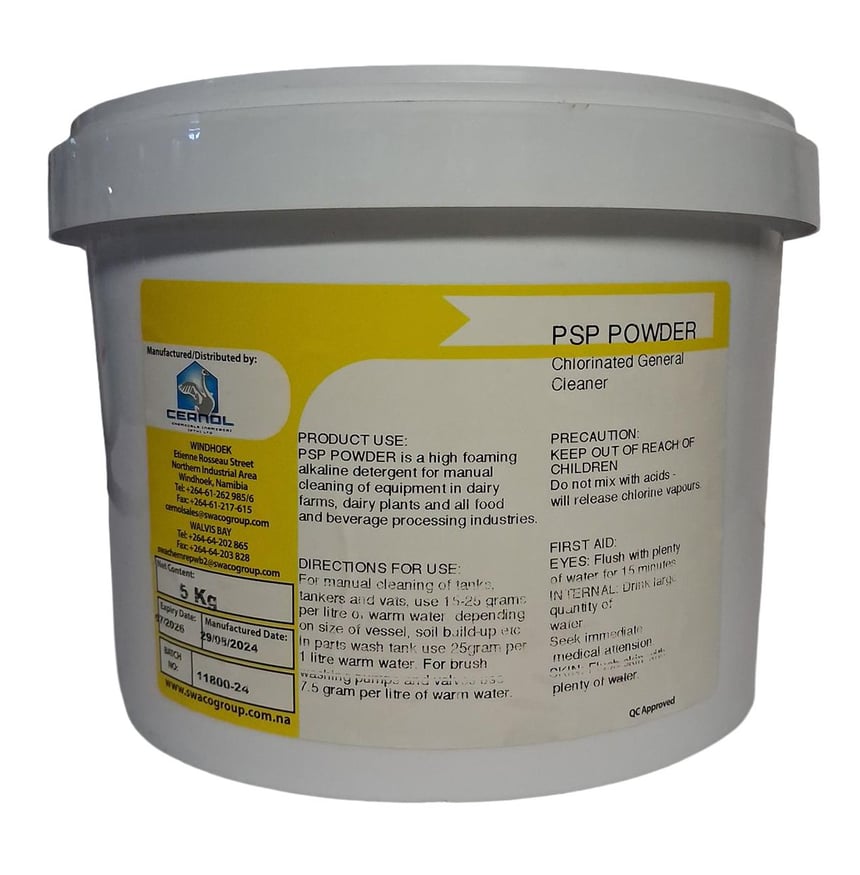
PSP Powder
Cernol Food HygieneFoodHigh-foaming chlorinated alkaline cleaning powder based on chlorine — dairy and fish-factory alkaline cleaner.
Available in5 kg25 kg
Available from: Windhoek & Walvis Bay agent
This is the heart of the relationship: the 3-step cycle — alkaline, acid rinse, sanitizer — that Cernol formulates in Windhoek and Namibian dairies, breweries and butcheries run every production day. The segmentation sheet spells the steps out product by product, and the plants that follow it pass their audits.
The cleaning log — product, dilution, contact time per line — is what EU-style and HACCP inspections examine; Cernol documents all three for every product supplied.
Put the sanitizer switch dates (the 6-month QAC ↔ chlorine rotation) on the plant calendar now — audits ask when you last rotated, and “when we remembered” is the wrong answer.
The lines food & beverage buyers draw from this category most.
High-foaming chlorinated alkaline cleaning powder based on chlorine — dairy and fish-factory alkaline cleaner.
Available in5 kg25 kg
Available from: Windhoek & Walvis Bay agent
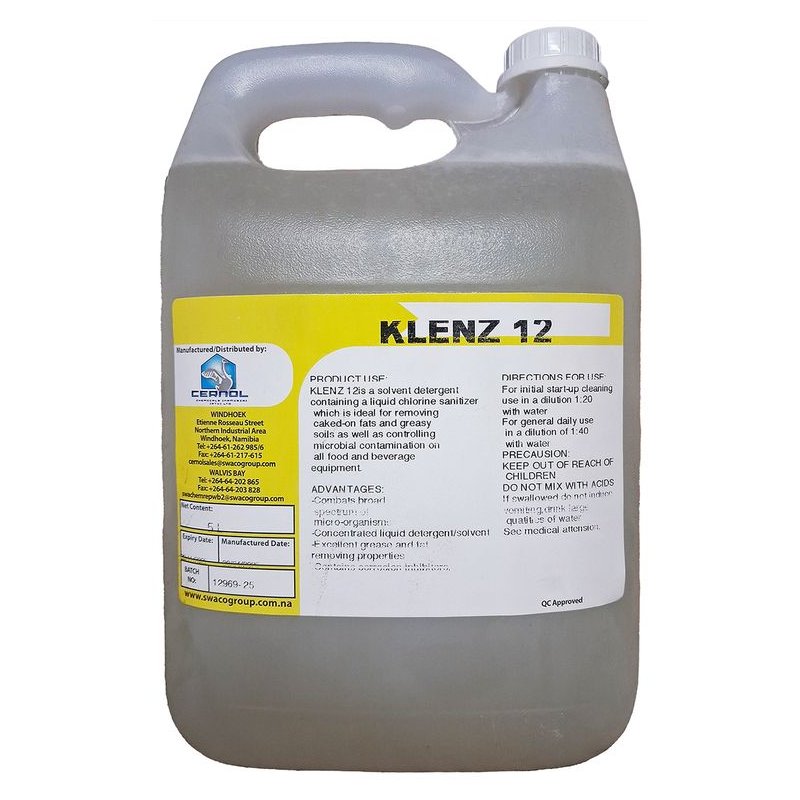
Chlorine sanitizer and solvent detergent (liquid) — dairy alkaline cleaner that cleans and sanitizes in one step.
Available in5 L
Available from: Windhoek
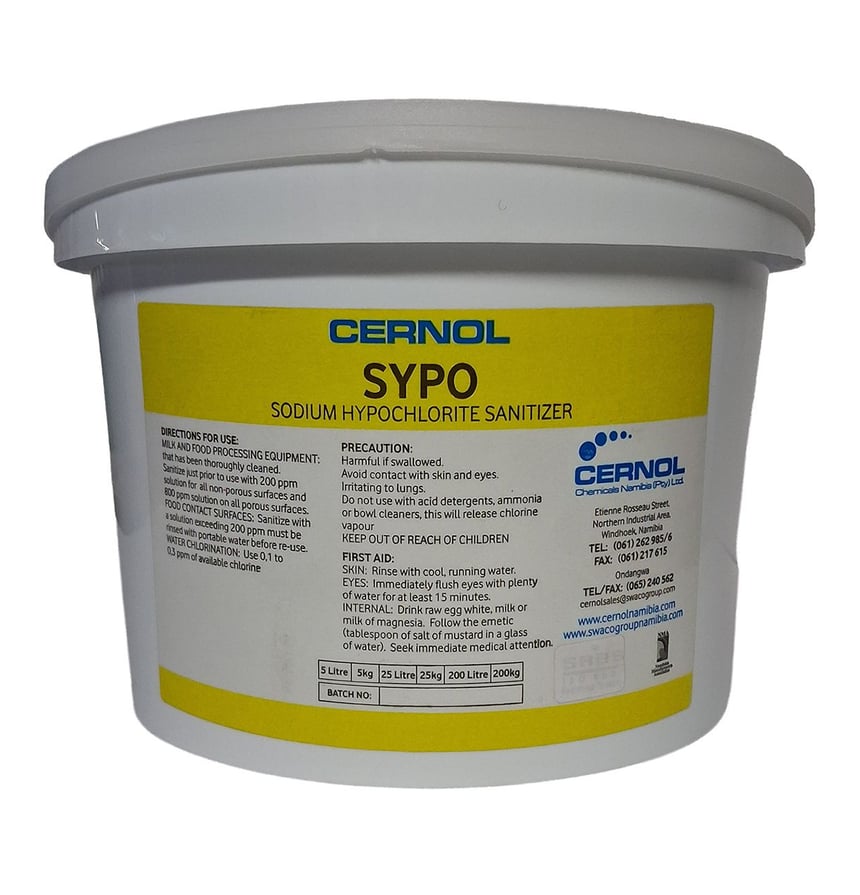
Sodium hypochlorite chlorine sanitizer for dairies, breweries and butcheries.
Available in750 ml5 L25 L200 L
Available from: Windhoek & Walvis Bay agent
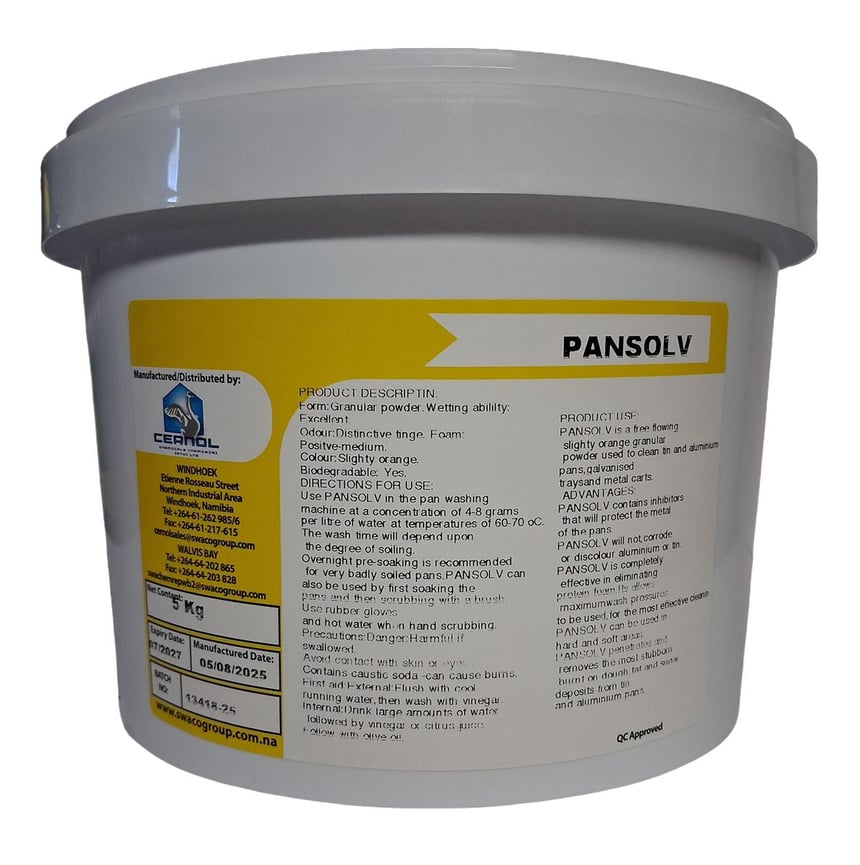
Heavy-duty detergent for pans, pots, racks and equipment at 50 °C+ — butcheries, Meatco and fishing factories.
Available in5 kg25 kg
Available from: Windhoek & Walvis Bay agent
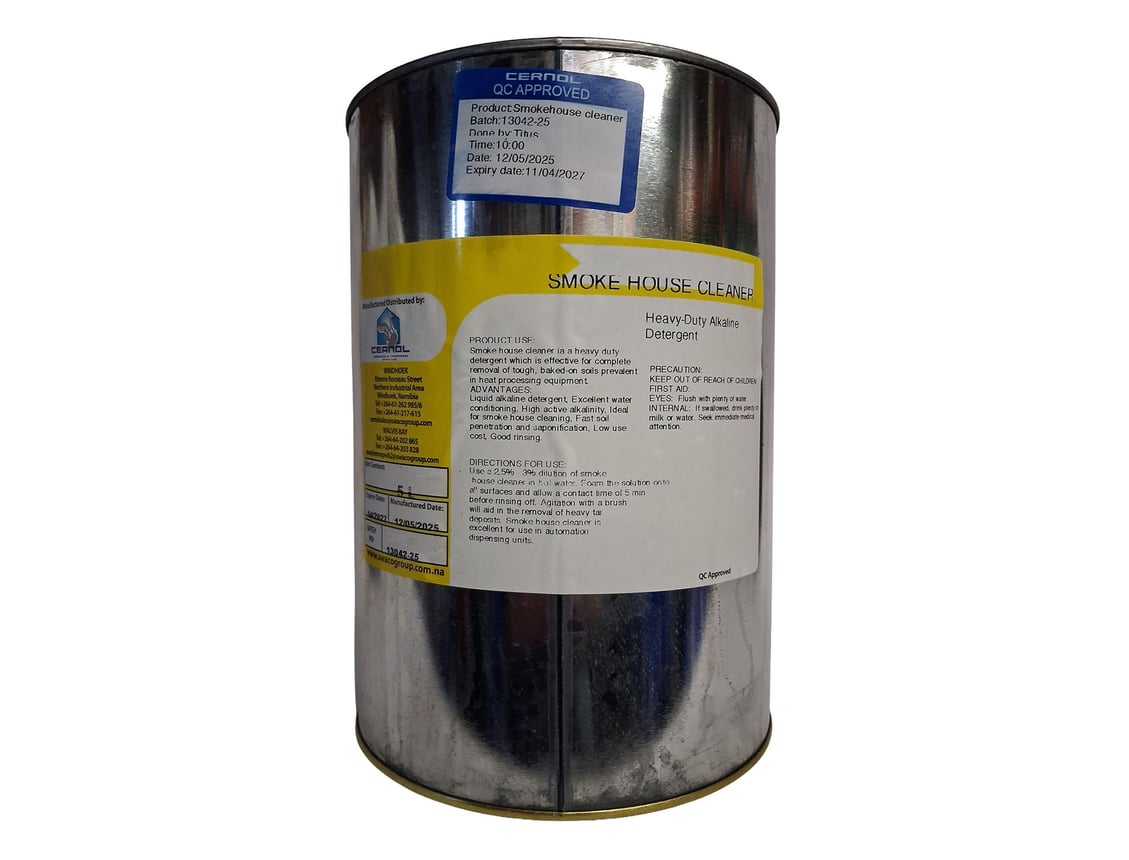
Heavy-duty alkaline cleaner for smokehouse cleaning (liquid) — all butcheries and fisheries.
Available in5 L25 L
Available from: Windhoek & Walvis Bay agent
Yes — the chemistry scales down: PSP Powder or Klenz 12 as the manual alkaline scrub, an Acidet or Hydrosan acid step made up in a dosing bucket, and Sypo or Tetramine 2008 as the terminal sanitizer. The steps and their order matter more than the pumps. Small Namibian dairies pass the same inspections as piped plants on exactly this manual version; what fails them is skipping the acid step, not lacking equipment.
By water hardness and what your surfaces show: with typical Namibian borehole feed, daily acid rinsing after the alkaline step is the safe default for milk-contact circuits, relaxing only if inspection shows no mineral haze. European guidance written for soft water suggests less — and that imported assumption is the single most common cause of milkstone build-up we see in local plants. When we survey your plant we set the frequency from your actual water, not a manual.
Warm the chamber slightly (residue softens), apply Smokehouse Cleaner to walls, racks and trolleys, give it the label dwell time to break the tar-fat glaze, then hot-rinse thoroughly and dry before the next smoke. Racks with heavy build-up go through a Pansolv soak at 50 °C+ instead. Butcheries that clean the smokehouse weekly with the right chemistry avoid the annual chisel-and-blowtorch ordeal — and the off-flavours old tar feeds into product.
The same cycle as the dairy, tuned to brewing soils: PSP Powder or Klenz 12 as the alkaline clean on tanks and lines, Acidet on the stainless the brewery lives on, and Sypo or Tetramine 2008 as the rotating sanitizer. Around the plant: Chlordet 110 on floors, Greasolv where lubricants and grime meet, and the hand-hygiene line at every entrance. Tell us the vessel sizes and we will spec the doses per circuit.
Cernol Chemicals Windhoek — Factory & Sales Office · Cnr Kallie Roodt & Etienne Rosseau Street, Northern Industrial Area, Windhoek · Tel 061 262 985 · Mon–Fri 08:00–17:00
Served primarily from Cernol Chemicals Windhoek — Factory & Sales Office — 061 262 985. SDS, grades and delivery scheduling included in the quote.