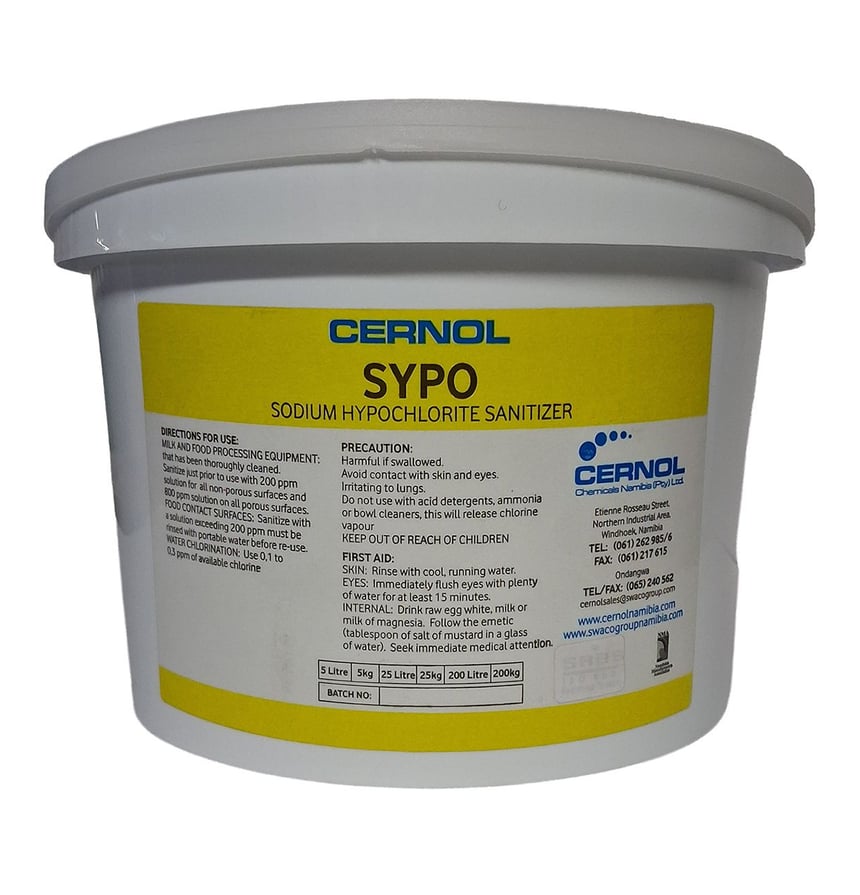
Sypo
Antisep 100FoodSodium hypochlorite chlorine sanitizer for dairies, breweries and butcheries.
Available in750 ml5 L25 L200 L
Available from: Windhoek & Walvis Bay agent
A food plant’s sanitizer is a moving target: run one chemistry for years and the plant’s resident bacteria learn to live with it. Cernol’s answer — written into the Food & Beverages segmentation sheet — is the 6-month rotation between Sypo, Tetramine 2008 and Hydrosan, all blended at the same Windhoek factory so the switch is a stock change, not a supplier change.
Sanitizer rotation dates, dilution records and contact times form the sanitation chapter of a HACCP file; we supply the documentation set with every rotation.
Colour-code the sanitizer dosing jugs to the current chemistry (blue QAC semester, yellow chlorine semester) — Namibian plants that make the rotation visible on the floor never accidentally run both at once.
The lines food & beverage buyers draw from this category most.
Sodium hypochlorite chlorine sanitizer for dairies, breweries and butcheries.
Available in750 ml5 L25 L200 L
Available from: Windhoek & Walvis Bay agent
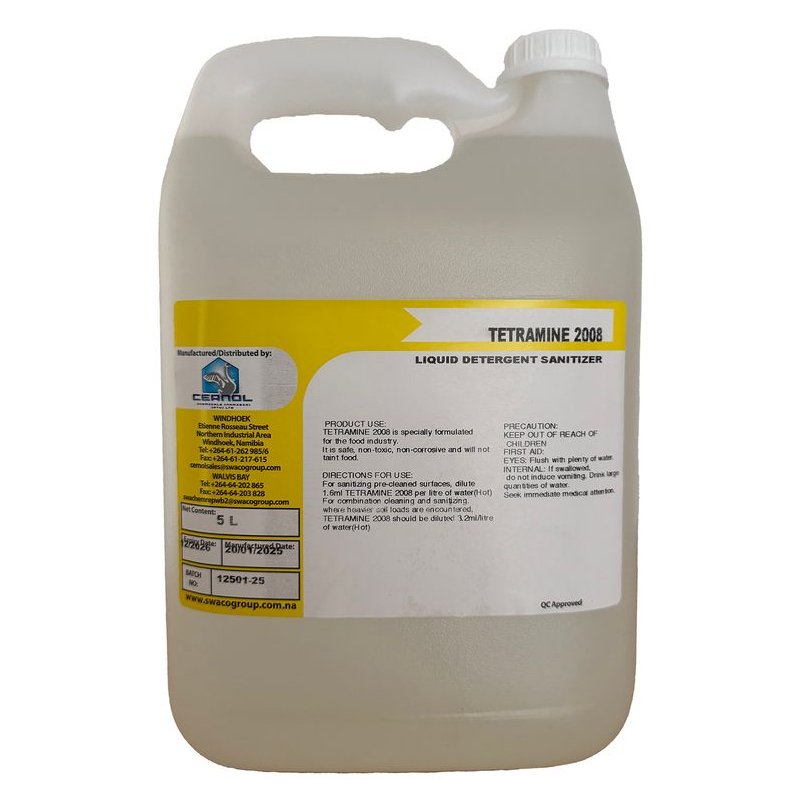
A liquid QAC detergent sanitizer for the food industry — the six-month rotation partner to chlorine sanitizers.
Available in5 L25 L
Available from: Windhoek & Walvis Bay agent
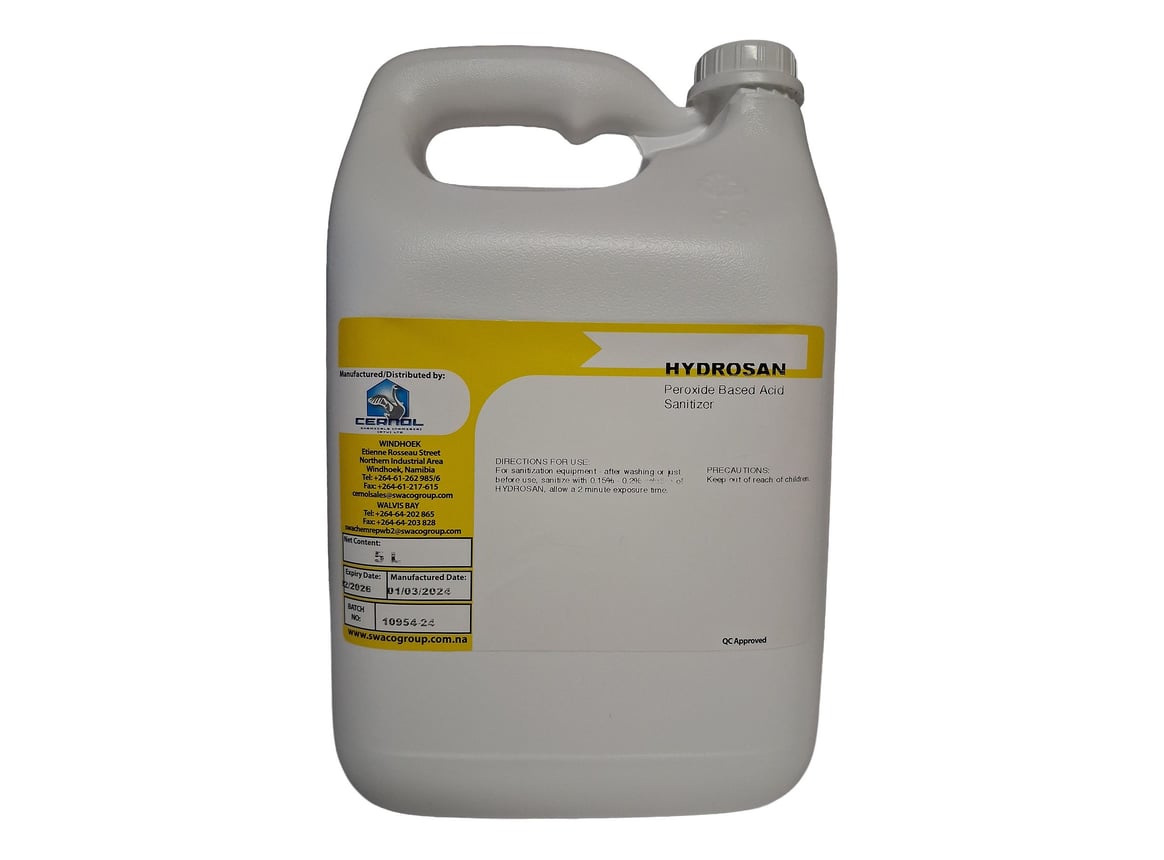
Peroxide-based acid sanitizer — acid rinse for dairies and rotation partner in the 6-month sanitizer cycle. Used at 3% as a disinfectant in institutions.
Available in5 L25 L
Available from: Windhoek
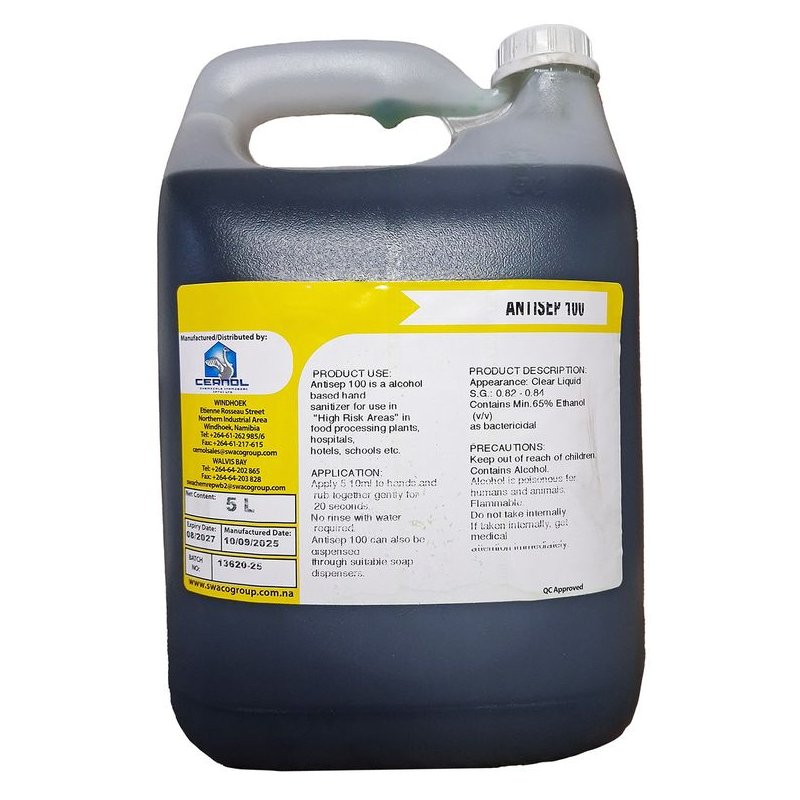
Alcohol-based hand antiseptic, WHO compliant — disinfects hands at factory, depot and office entrances.
Available in100 ml300 ml spray500 ml5 L25 L
Available from: Windhoek & Walvis Bay agent
As a stock change on a calendar date: the segmentation sheet’s instruction is six months on a QAC (Tetramine 2008), then six on chlorine (Sypo) or hydrogen peroxide (Hydrosan). Dosing points stay, procedures stay, only the drum and the dilution figure change — we supply the new dilution card with the first rotated delivery. Plants that rotate on schedule hold their swab counts flat year-round; plants that “stay with what works” watch it work less every quarter.
Hydrosan is the peroxide-based acid sanitizer — the third chemistry in the rotation, and the one that conveniently combines the acid step and the sanitizing step where a circuit suits it. Many plants run Hydrosan on the closed circuits and Sypo/Tetramine on open surfaces within the same rotation calendar; its peroxide action leaves no chlorine or QAC residue question behind. It is listed on the sheet as the dairies’ acid rinse for this reason.
Three points in sequence: Chemkleen Clear at the wash basin (a disinfecting soap, dispensed, never bar soap), paper towels from the consumables range, and Antisep 100 at the door as the final alcohol step. That entrance line is what inspectors watch first because it predicts everything else. Refill from bulk, log the refills, and put the same setup at toilet exits — the segmentation sheet lists Antisep 100 for “factory and workforce” in exactly these positions.
Keep the two regimes strictly separate: plant sanitizers belong on food-contact surfaces at plant dilutions, and whatever chemistry serves the livestock side must never wander into the processing hall — dedicated sprayers, dedicated storage, dedicated labels. Cross-contamination between farm-side and plant-side chemistry is a classic audit finding precisely because the same hands work both. Ask our team for guidance on the farm-side regime; the separation discipline is the part we can help you design.
Cernol Chemicals Windhoek — Factory & Sales Office · Cnr Kallie Roodt & Etienne Rosseau Street, Northern Industrial Area, Windhoek · Tel 061 262 985 · Mon–Fri 08:00–17:00
Served primarily from Cernol Chemicals Windhoek — Factory & Sales Office — 061 262 985. SDS, grades and delivery scheduling included in the quote.